Product Application

Electronic control unit (ECU), DC/DC converter, LED driver, motor controller, HVAC system, and infotainment module all connected to a common 12V power bus. During normal vehicle operation, the power bus is subjected to various transient over-voltages, with Load Dump representing one of the most severe conditions.
What is a Load Dump?
A Load Dump transient occurs when the alternator is charging the vehicle battery and the battery connection is suddenly interrupted due to a loose terminal, corroded connector, or maintenance operation. Without the battery to absorb the alternator output, the stored electrical energy is applied to the vehicle power bus as a high-voltage, long-duration over-voltage pulse that may threaten downstream electronic system.
Load Dump Test Requirements in ISO 16750-2
ISO 16750-2 is an international standard that specifies environmental and electrical test conditions for road vehicle electrical and electronic equipment. It is widely used to evaluate the ability of electronic components and modules to withstand supply voltage variations, transient over-voltages, and other electrical disturbances encountered in actual vehicle operating environments.
Among these tests, the Load Dump test simulates the transient over-voltage that occurs when the battery is suddenly disconnected while the alternator is charging. The standardized Load Dump test conditions defined in ISO 16750-2 help verify whether front-end protection devices provide sufficient over-voltage protection capability, including effective voltage clamping and energy absorption, to protect downstream electronic modules from Load Dump over-voltage stress and improve overall system reliability.
Test A and Test B
A Load Dump waveform is characterized by a rapid rise to a high peak voltage followed by a gradual decay, with a pulse duration ranging from several tens to several hundreds of milliseconds. Compared with nanosecond- or microsecond-scale transient disturbances such as ESD and EFT, Load Dump transient delivers significantly higher energy over a much longer pulse duration, placing more stringent demands on the energy absorption capability and thermal robustness of protection devices.
Based on whether the vehicle electrical system incorporates centralized Load Dump suppression, ISO 16750-2 classifies the Load Dump test into two categories: Test A (formerly ISO 7637 Pulse 5a) and Test B (formerly ISO 7637 Pulse 5b).
| Item | Test A | Test B |
|---|---|---|
| System Condition | Without centralized load dump suppression |
With centralized load dump suppression |
| Waveform Characteristic | Higher peak voltage and more severe energy stress |
Lower peak voltage after system-level suppression |
| Waveform | 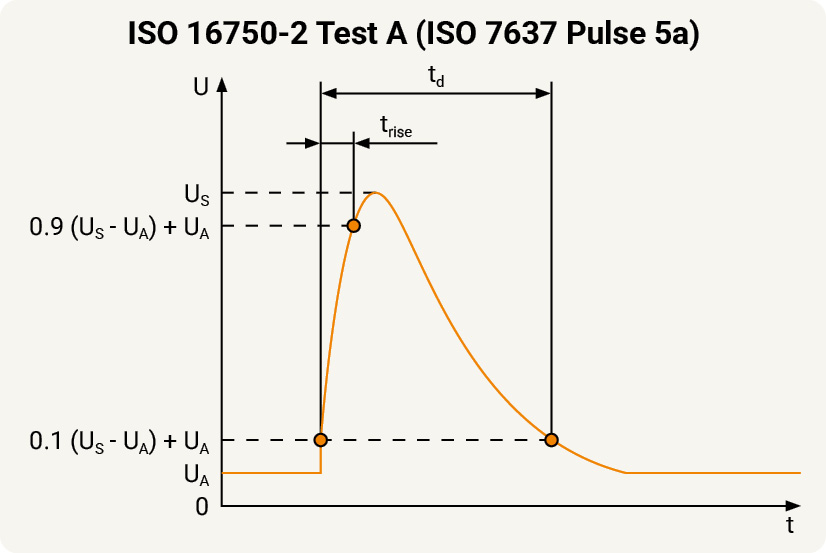 |
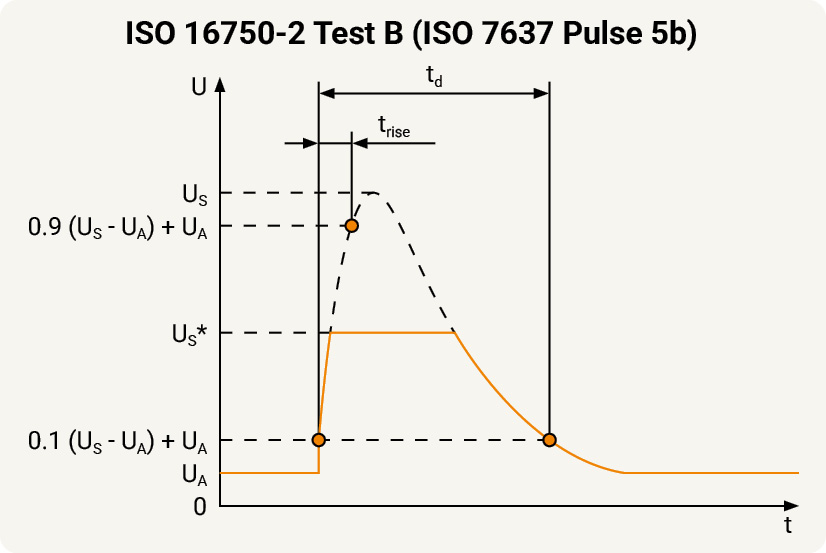 |
ISO 16750-2 Load Dump Test Conditions
| Parameter | 12V System | 24V System | Description |
|---|---|---|---|
| Us (V) | 79 ≤ Us ≤ 101 | 151 ≤ Us ≤ 202 | Load Dump peak voltage |
| Us* (V) | 35 | 65 | Suppressed Load Dump peak voltage |
| UA (V) | 14 | 28 | System supply voltage |
| Ri (Ω) | 0.5 ≤ Ri ≤ 4 | 1 ≤ Ri ≤ 8 | Test generator internal resistance |
| td (ms) | 40 ≤ td ≤ 400 | 100 ≤ td ≤ 350 | Pulse duration |
| tr (ms) | 10 (+0/-5) | 10 (+0/-5) | Rise time |
| Number of Pulses | 10 | 10 | Interval: 1 minute |
Why Use Surface Mount Varistors for ISO 16750-2 Load Dump Compliance?
Surface mount varistors are capable of handling long-duration, high-energy transients while maintaining reliable voltage clamping performance and are therefore well suited for compliance with ISO 16750-2 load dump requirements. They exhibit nonlinear voltage-current characteristics and remain in a high-impedance state under normal operating conditions. When a load dump event or other transient over-voltage occurs, varistors rapidly transition to a conductive state, limiting the voltage to a safer level while absorbing surge energy. This characteristic makes surface mount varistors widely used as front-end protection devices for automotive power line.
Surface Mount Varistor for 12V Automotive Power System Load Dump Protection
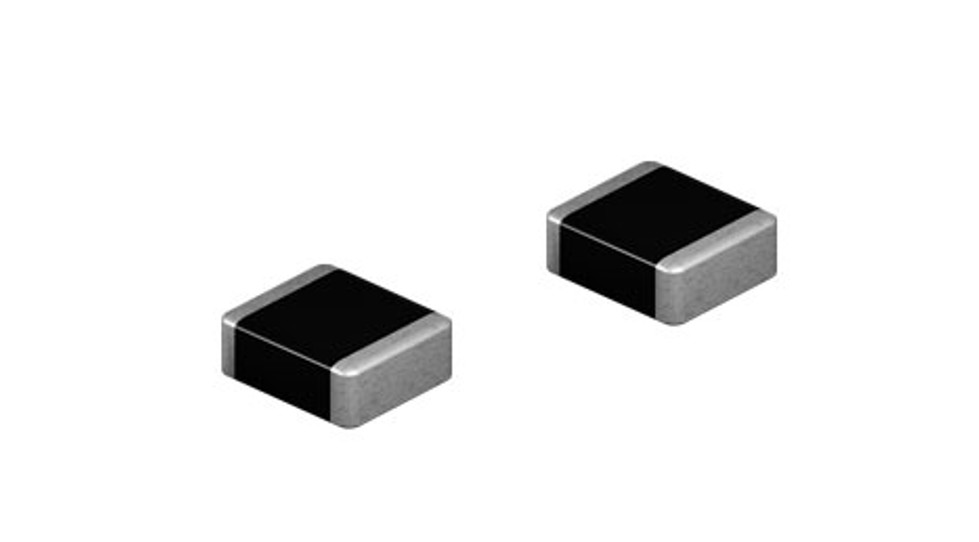
THINKING's TVM6C160K453RV is an EIA 2220 varistor specifically engineered for 12V automotive power system protection. It helps mitigate the damaging effects of Load Dump, Jump Start, and other transient over-voltage events on electronic control unit (ECU), battery management system (BMS), automotive power module, and other low-voltage electronic system, thereby improving overall system reliability.
Protection Performance
TVM6C160K453RV provides a Load Dump energy rating of 50J. It withstands 10 Load Dump test pulses in accordance with ISO 16750-2 for protection against long-duration, high-energy transient over-voltages. Compared with other protection devices of similar package size, it delivers higher energy absorption capability while minimizing PCB space requirements. This helps designers balance circuit miniaturization with over-voltage protection performance.
In addition, the TVM6C160K453RV varistor withstands 24.5V for 5 minutes under Jump Start test conditions. This provides additional voltage withstand capability beyond its rated maximum continuous operating voltage of 16 Vdc, allowing the varistor to accommodate temporary high-voltage transient resulting from external jump-starting, battery over-charging, or other abnormal power supply conditions.
The device also features a surge current handling capability of 5000A and a maximum clamping voltage of 40V@10A for rapid transient over-voltage suppression.
Together, these capabilities help improve the immunity of automotive power systems against transient over-voltages and reduce the risk of damage to downstream IC, DC/DC converter, MCU, and sensor module.
Features of the Surface Mount Varistor
- AEC-Q200 qualified for automotive reliability
- Space-saving 2220 surface-mount package for automated SMT assembly
- 50J Load Dump energy rating for high-energy Load Dump transient protection
- 24.5V / 5 min Jump Start withstand capability
- 5000A surge current handling capability to reduce high-energy transient stress on downstream sensitive components
- Bidirectional protection to suppress both positive and negative transient over-voltages and simplify circuit design
- Operating temperature range from −55 °C to +125 °C for harsh automotive environments
- RoHS & Halogen Free (HF) compliant
Product Specifications
| Part Number | Package | Varistor Voltage V1mA (V) |
Continuous DC Voltage VDC (V) |
Clamping Voltage (V@10A) |
Jump Start Withstand (V / 5min) |
Load Dump Energy (Joule) |
Surge Current (8/20µs) (A) |
Operating Temperature (°C) |
|---|---|---|---|---|---|---|---|---|
| TVM6C160K453RV | 2220 | 24 ±10% | 16 | 40 | 24.5 | 50 | 5000 | -55 to +125 |
Recommended Applications
- Automotive lighting system (LED driver)
- Electronic control unit (ECU) and body control module (BCM)
- DC/DC converter
- Motor control module
- HVAC control system
- Sensor module and control module
Automotive power protection against Load Dump, Jump Start, and other transient over-voltage events requires protection devices with both fast voltage clamping and high energy absorption capability. Designed to meet the requirements of the ISO 16750-2 Load Dump test, THINKING's surface-mount varistor combines exceptional energy absorption capability, effective over-voltage clamping performance, and AEC-Q200-qualified reliability to help engineers develop safe and reliable automotive power protection solutions. For product selection assistance, samples, or additional technical information, please contact us.